11
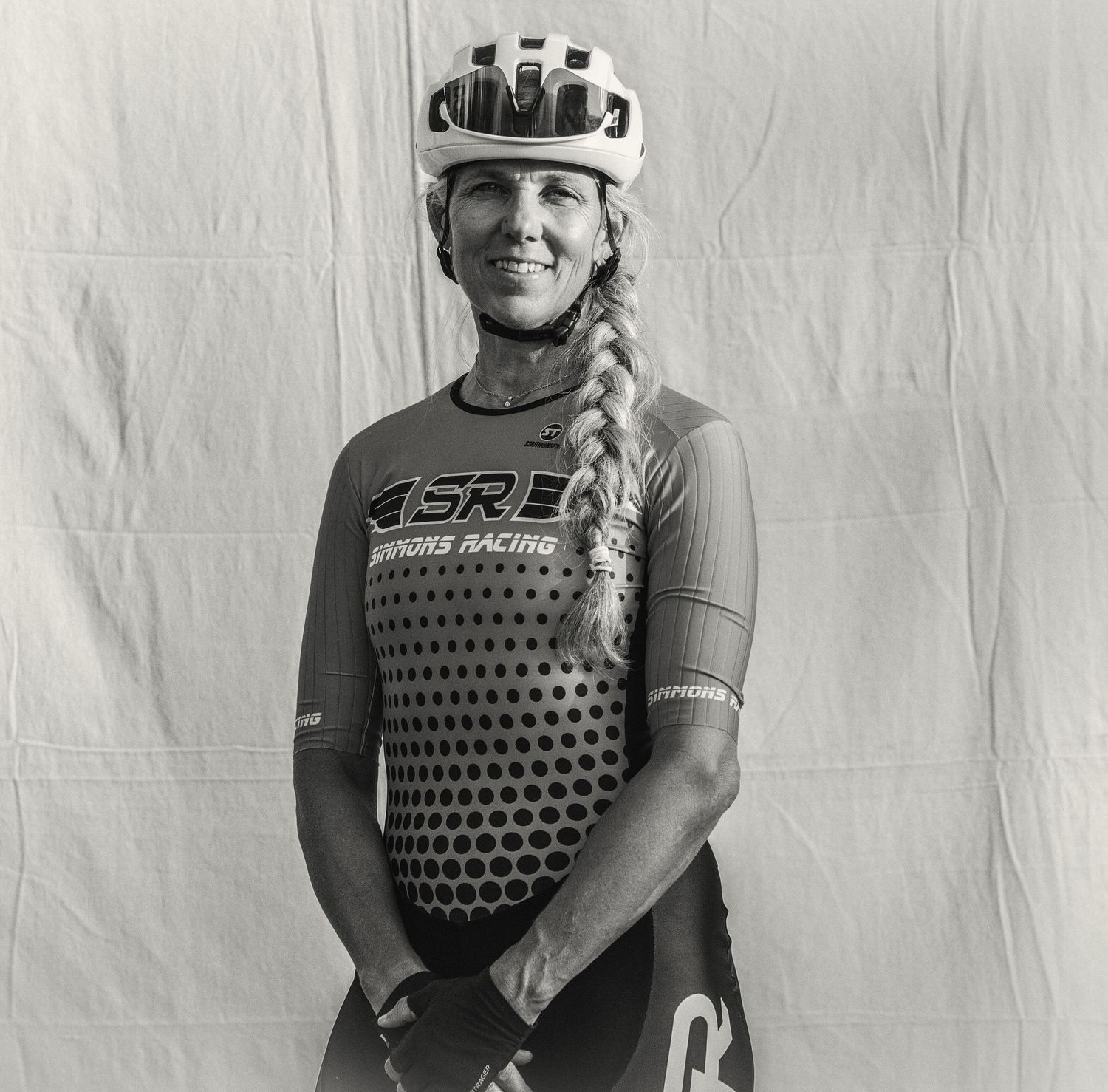
SPEED SKATING / CYCLING / PRO

Heather


MAMIYA c220 / TRI-X & T-MAX 120 FILM
Learning from your losses.
AN INTERVIEW WITH HEATHER LAUFER
by
Respect Their Game
Welcome to the Respect Their Game — a collection of conversations with women athletes about commitment, identity, discipline, and the interior life of sport. These interviews are part of the ongoing portrait project documenting women in sport through film photography and their own words. Five-time roller speed skating world champion Heather Laufer shares how elite speed, tactical pack racing, and resilience shaped her journey from growing up on skates to international titles and a career in physical therapy, Pilates, bike fitting, and anatomy education.
Please introduce yourself, Heather.
My name is Heather Laufer. I am a five time world champion in the sport of roller speed skating that which encompasses two individual titles, a relay title and two overall titles. Aside from that, I’m a mother of two. I am a physical therapist. I also am a classically trained pilates instructor and an adjunct professor of anatomy at OSU OKC.
I am getting back into bike fitting, I will joining the team at Capitol Co-op on Robinson and 24th in the historical Capitol Hill District in Oklahoma City.
And bike fitting is getting a bike fit to a person?
Yes, Exactly! But for me, it’s the culmination of all the things I love. It’s the sport, it’s the physical therapy (PT) background and the goniometers and the measurements and the angles and all that. And getting the most power out of the person on the bike, making them the most efficient as possible. I am in a unique position to add to that as well by offering “bike-hab”.
When assessing muscle imbalances and designing a home exercise programs to increase strength or decrease tightness.
And what are your PT credentials?
I have a master’s degree in physical therapy and have been practicing for 16 years. I love it! This degree also allows me to teach anatomy as an adjunct professor. It’d be hard to take on another full-time job, but it’s just a whole lot of fun to teach the pre-PT students and students going into nursing and other health related fields. My instruction and classwork is very biased towards my profession. So they get some extra, clinical pearls which I hope helps them tether the names of structures, too.
Do you think your knowledge in PT and anatomy helped you in your sport? Did it give you some kind of advantage?
Well, not in my previous career because I didn’t have these credentials as a young skater, but certainly now. For sure now. I think the more you know about the thing, the better you can be at the thing. So we all own a body and it’s amazing to me how many people know nothing about their bodies. This is your property. Learn as much about it as you can. Keep it running smoothly. I like to share my knowledge and help out at clinics. I’ll do crit (criterium) clinics on the bike, which is crit racing, this is my favorite kind of racing on the bike! it is very much like skating. So I think that’s the grab for me there. At these clinics we go over cornering and strategy and those sorts of things, and also clipping in and riding in a bunch. I also get to go back and work with Future Team USA, USA Roller Sports Clinics as a demonstrator, and an educator in race day preparation, strategy and nutrition.
What should you be doing? Where is your focus supposed to be? What does your nutrition look like? I’m not a dietician, but just giving them the basics to get them started and then shooting them towards somebody that is a professional that can help them really, really dial in their nutrition. I always come across new knowledge and I’m like, only if I knew that back then! How much faster would I have been? But I think I did do things pretty good back then, which has set me up to be able to go back to the sport at 40 something and then find a new sport after that.
How did sports first become part of your life?
They have always, for as long as I can remember, been part of my life. My parents were roller skaters, which meant my brother and I were roller skaters. At first they put me into artistic skating because that’s what they did. One of the coaches said I needed more speed for my jumps and spins. So they took me to a speed practice and that was pretty much it. I mean, I had to do a bit of artistic stuff and my brother was my dance partner and that just led to disaster after disaster. So they were just like, let’s just put them in speed skating. I started competing at the age of four. So it’s ingrained.
Was that inline at the time?
No, that was roller skating. My Facebook profile picture is me as an itty bitty baby with roller skates on my feet, just completely crashing out. We always had skates on our feet. My parents liked to say I could skate before I could walk. They would put me in it, a baby walker and put skates on my feet (so I couldn’t climb out) and then put me out in the center of the floor. So I just would push myself around the floor while they did their dance skating.
And your parents were in the sport professionally?
I wouldn't say professionally, no. My dad coached. He was my coach for many years.
What led you into inline?
Inline skating became in vogue in the early 90’s. It was the fastest growing sport in the United States at the time. Before that time I had been in roller skating, competing at the national level, until I was 12.
Then I returned to the sport at 18, and I think because I really needed to be successful at something and I wasn’t really finding it anywhere else, but I knew I used to be good at this. So why don’t we just go back and do something that we’re good at?
"This is great." So no sooner do I get going with the team and we’re on quads, the coach decides “In-lines are the future." And he was right, In-lines were the future of racing and we were just slightly ahead of the curve!
We would go to races and we’d get disqualified out of every race we skated because we were the bad guys. We were on these... They couldn’t say we couldn’t skate because it’s still roller, but they just weren’t ready for the transition yet. Quads and In-lines are two distinctly different sports. And I really feel like inlines took my sport from me. Even though I was able to be quite proficient on them. it doesn’t not matter the length of time I’m off my quad skates, that’s like a fish going back to water. If I’m off my inlines for a period of time, I get back on them like, oh, let’s just kind of take it slow. I don’t know. Cornering is just different. So I do feel like inlines took my sport.
So was there a moment you realized you weren't just good, you were like really, you could compete with the best in the world?
At an international level, that took some time. I knew that, especially back then when I was getting back into it, I had a bunch of aggression that I needed to get out and what a great way to do it. I would go to practice and I would always skate with the boys and get knocked around and just like, I just love that. Let’s go harder. Let’s go faster. When I initially went back to the sport, I had no idea that there was a world team. I don’t know that it was ever discussed with me as a kid. Even though I, it’s funny to even think that because I knew who the world team members were, but I never associated that with a separate thing or a separate goal to work towards.
My coach at the time, Joe Cotter, had been a world team coach, I was like, wait, there’s a world team? What’s that about? "Well, you got to go to bank track nationals." And I was like, "All right."
International competition is outdoors on road courses and banked tracks. There’s really good carryover from indoor, which is what we were doing on a hundred meter flat track to this 250 meter parabolic bank track that is in Colorado Springs.
That is the crossover of sports again, the cyclists think our skating velodrome is their warmup track, but it is actually a parabolic design specifically for roller speed skating.
You have to go to clinics, a lot like the ones I help out at, to become proficient at skating the track and then qualify to compete on it.
Returning to the sport at 18 made me Senior World Class and therefore able to tryout for our national team. So I put all my effort into that and made the world team in a really classy fashion. Back then we had a 300 meter time trial, a 500 meter, a thousand, 1500, a 3000, a points race and a last man out, (scratch race). So you had to be able to go from a raw sprint all the way to a 10K. And there was no specializing back then. The world team was four members, four women, four men, and accumulation of points over those seven distances is what secured your spot. So you had to be able to do all the distances. You couldn’t specialize. But that’s how the overall titles were awarded as well. So I had won four races placed in the other three and was headed to the world championships. And it wasn’t like I let my foot off the gas.
I just had no idea what was coming my way. So we trained. We got myself on the schedule that I’d be on in Italy. I had never really flown before. I think the first time I flew was when I had to fly out and do our training camp before we went to Worlds. And then the second time I flew was to Italy. So it was traumatic.
I am much better at flying now. But international competition is just really different. It’s really different. And I had no idea. I mean it’s very handsy, it’s very physical because on the bicycle our hands are on our handlebars. Skating, your hands are free to be where ever.
If you’re not swinging for momentum, then you’re making room for yourself in the pack and moving people over and getting moved over and stuff like that. So I got my butt kicked so badly. So that was not... I didn’t leave there with the idea that I could compete internationally. I left there with the idea that I’ve got to go back to the drawing board. I got to go fix this. And so the only good thing I’ve seen is that I took those as lessons and then as ways to go back and refine what I was doing and then set up for the next time. I actually traded my tracksuit for an Italian tracksuit that I wore every day to remind myself that I got my butt kicked in Italy and that I was training every day to make sure that that never happened again.
What do you remember most about representing Team USA for the first time?
Well, for the first time I got my butt kicked. And I was like, I’m an embarrassment. I just don’t know what happened. But when I think about that, I think about the first time the national anthem was played not in my honor, but because I was on the podium representing the United States. And that is so, it still will make me teary now because that’s such a powerful experience.That’s the culmination of all your hard work. And the world championships is still the peak of what we have for inline skating, which is crazy when you consider the crossover into ice skating. I would say concurrently and then either as their secondary sport, I would roughly estimate 70%, especially in long track. And those are all inline skaters, but inline skating doesn’t go to the Olympics. So you have to cross over and you choose either long track ice, short track ice or a cycling sport.
For someone who's never watched speed skating, how would you describe it?
So it’s fast. It’s fast and furious. It’s tactical. You can see the raw strength or the finesse in the athletes. There’s usually power skaters or you’ve got a bit of finesse. It’s pack dynamics, it’s in close. With very little room for error. We don’t have bicycles separating us like you would in a Peloton or a crit race, you’ve got to give some space for the other rider. In skating, we don’t have that. We are as close to that other person that if we’re in the pack and we’re drafting, you are almost hovering over their back. It’s exciting. It’s filled with adrenaline and it’s actually one of the most exciting sports to watch.
Does it look at all similar to short track in the Olympics?
Yes. So not as many wipe outs because we’re not on ice and our wheels give us a little bit more grip. And then the surface that we skate on is treated. It’s a product called roll on (for indoor racing). Very, very grippy. When a floor is laid down for say nationals or a big championships, if you fall on that, your skin stays and you keep going. You’re not sliding all the way to barriers. We don’t even put barriers up like that spongy barriers to absorb impact.
Are you wearing similar outfits to short track ice skating?
It’s going to look more like this. Shorts and then short sleeves. Maybe some long sleeve, maybe some people will put some longer garb on. I’ve seen some things just with compression era garments coming into Vogue. Maybe we see a little bit more of that, but usually it’s something very similar to a kit like we would wear for cycling — just no chamois.
What makes someone successful in speed skating beyond simply being fast?
Being able to corner. Being able to read the race and to feel the surges and the moves that are about to happen. Knowing the course. So like the parabolic banked track in Colorado Springs, you have to know how to skate it. There’s a dish. And if you’re out of the dish, you’re losing speed. The dish is built in. Now the game changed a bit when inlines came onto the scene because we could just stay down on the red line. We never had to even hit the dish. But as inlines have progressed as far as the wheels are better, the wheels are faster, we’re definitely getting into the dish and they’re using the bank track more. You can pin people, you can get speed off of the hump as you come down. You have to be able to skate the course. So cornering is always hugely important.
That’s where we pretty much build our speed and then maintain through the straights unless it’s just like a... They do a hundred meter drag race now, which is basically running on your skates. Very little skating involved in that. And that’s just in a straight line. But mental toughness and being a bit fearless for sure is going to help a skater out. If you hesitate, opportunity’s gone. So you’ve got to be able to read the race, feel the movement of the pack, know when to burn your matches and know when to not.
So that's more of a tactical thing, right?
Right? Hugely tactical. Yeah. Because a lot of the races, aside from the hundred meter drag race, that’s just go from the gun and you’re in your own lane straight line. We didn’t do that back in my day. So all of it was either you had to know where every footstep went on that track. The second world championships I did was actually in Colorado Springs. So home track advantage. But I’m telling you the amount of time that we spent in... We had everybody at the Olympic Training Center was kind of at our disposal. So every day in the lab doing visualization where every single footstep was going to go on that track and memorizing it. So when you got there, it was just autopilot. And it’s amazing that those tactics can be also put to a clock and you can decrease your time and have it transfer to the track.
So great. When you’re creating those neural patterns, the brain doesn’t really know if you actually did it or if you visualized it. So you can really capitalize on that and improve your efficiency.
What's something people consistently misunderstand about your sport?
So when I was little, everybody though we were doing roller derby, which was like, what? But roller derby now, roller derby as it stands today is a phenomenal sport. So it’s not offensive. Do you know what I mean? Whereas before we were just like, "No, that’s not what we’re doing." But roller derby now has ascended and it’s a phenomenally hard, vigorous sport in and of itself. It’s not like the staging — not theater at all whatsoever. So now I think mostly they’re just like, "You rollerblade?" Question mark. "Oh, I have rollerblades. We can... " Yeah. And I’m just like, "No, no, no, no. It’s not really that. " And that’s also funny to me too, because back when I was skating, I was on one of the first pro teams and Rollerblade was our sponsor. It was Chevrolet Geo and Rollerblade. And it was just like, "No, well, yeah. Yes, Rollerblade sponsors us, but it’s not really what we’re doing." So I think that was always the biggest misconception. More like how cute rather than, "Oh, wow." Because I think if they ever really watched the sport, they’d be like, “Oh, wow."
So becoming a world champion, winning on world championship is extraordinary. What does it take to win five?
Dedication. Well, and I’ll say too, we have a lot of opportunities. In my era of skating, you had seven races. I had seven opportunities to gold medal. It’s just not that easy. I mean, you really have to figure out why you’re even out there. And if it’s truly in your heart and truly in the pursuit of excellence, that’s what will keep giving you the opportunities to go back and try to claim the titles.
Are you saying today’s athletes don’t have as many opportunities?
They don’t have as many opportunities because say you make the US team for 2026, they’re only allowed to put two skaters in each race now. And they take eight people. When I skated, they took four people and they could put three people in each race. It’s a lot of opportunities.
I think the reason actually is my era of racing, countries were sweeping the podiums. And so it was just a way to not let that happen anymore. So it’s two in each race. And now there’s no longer an overall title, which two of my titles are overall titles. So that forced people to specialize. So you’re either a sprinter or you’re a distance athlete.
Do you remember your first world title differently than your last?
Oh yeah. I can look in the bucket and see what the jersey says for my first one, my individual, but I can remember almost every bit of the last 400 meters of my last one because we have those opportunities, right? Seven races. And I went to the worlds as a sprinter. And when I tell my friends the story, I’m like, "Man, I messed up every opportunity to get a gold medal." And I was not leaving France without a gold medal. I was like, "I am not leaving. Either I’m learning to speak French or I’m leaving here with a gold medal." the 300 meter time trial — fourth by time just off the podium, 500 meter silver medal, nipped at the line, 1,000. Either silver or bronze, I don’t remember. 3,000, same thing. I’m still hitting the podium, but it’s not what I’m there for. And in the longer races I was a domistique and I was the domistique for Teresa Cliff, who actually is our first road world champion in the history of ever for the us women. which was great to be a part of! I don’t know that she needed me as a domistique, but that was my role.
She’s a powerhouse all in of herself. that was the points race. So that race is shorter and then the scratch race, I was also the domistique for that. I don’t remember who or how we did. I don’t know if we podiumed in that or not, but I’m there working for my teammates. The marathon is the last race of the competition and there’s no designated winner. They’re just like, "Go skate your race." And I was like, "Well, I guess this is it. It’s got to happen here. There’s no more races." And the last 400 meters we finished on the track that we had been racing on for all the other races. The race started on the track and then we went out into the city, we skated through the city, and then we came back and we finished about the last 400 meters on the track.
And I came into the arena in second place and I was like, "Huh? Second place." And I looked up the road and she maybe had a hundred meters on me. And seriously, no offense to my competitors, she was struggling. And I was just like, "Oh, I could get her. All I have to do is go back to the basics because she had lost form completely. She was just trying to get to the end of the race. All I could hear was my heart beating in my ears. And I just went back to basics. Literally everything I had trained on form and technique and I knew how not to skate that last turn because that’s what got me off the podium in the 300 meter TT. So I was like, this is my chance to do it all right." And I think I couldn’t believe it the most when I crossed the line first because I was just like, "No, I did it." We had never won a marathon title prior to that. We had never won an overall road title prior to that. So that was a big win. Yeah. Nice.
And I can’t even, like I said, I can’t even tell you if it... I think it was a 1500 meter or it was a 3000 for my first one, but that last title! That one was the best! And I went as a sprinter. And it’s funny, people only remember that one. And so they’re like, "You’re a distance skater." And I’m just like, "No. No, I’m not. I might be better at it now just from the bike."
In this stretch and this run of your championships, did you have a rival?
Well, so the top was very competitive. So outside of our US jerseys, we were all rivals. We were all on different trade teams. We all competed against each other. Nationals, you’re not guaranteed your spot. You have to defend every year. You have to make the team every year. So we were all rivals unless we were wearing our stars and stripes. Then we were a cohesive unit. But outside of that, and I’ll say that for me is with anybody, even my best friend, the moment we step foot on the track. We can be the best of friends until we’re on the track. When we’re on the line, all friendships are set aside. But in the same token, everything that happens on the track stays on the track. We can go back to being besties after the race.
Is that just you or you think that's everyone at that level?
I don’t know. I don’t know. I want to say there’s an understanding at that level because I threw a really crummy pass on my best friend and I made sure both of us didn’t medal in the race. And I think the madder person was her dad. He was really upset with me and she was just like, "I mean, you could have not thrown it. " And I was just like, "Well, yeah, I could have not thrown it. " But then what? I wasn’t going to race for second, right? I don’t know. But yeah, no hard feelings. Not that I know of.
I was just curious because the sport you compete in is very centered around obviously times and rank-ings and finishings. How do you kind of disconnect your self-worth from these types of metrics and what do you refocus it on?
That’s a really great question. I think it’s really... So now even, cycling does have a ranking system and you can look up at any point in time, how am I ranked? Where do I stand? I don’t look at those things. And I even take that further as to when I’m going into a race, I don’t look at who’s registered to race. I don’t make any predeterminations about any part of the race. I feel like you can know you’re... I think I’m a little bit at a disadvantage in cycling because I don’t really know everybody, but in skating, I certainly did know everybody. I don’t look at what anybody’s stats are. I don’t look at any of that and in cycling there is even a race predictor. I sure as hell don’t look at that. I just don’t. I try to insulate myself from those pressures. The difference in skating is we knew what each other’s strengths were. I knew I was going to get my legs run out in a long distance race against one of my competitors because she liked to go from the gun and just could just keep on going, pushing the pace and still have it for the end. So I already knew those kinds of things.
Then my strategy would be to break the momentum, like get in front of her, slow her down, And to me, nothing carries forward from the previous year. So say you were the national champion last year. Well, that doesn’t mean anything for this year. That means you’re someone to watch or if it’s me, that means I need to train probably harder to maintain that position. But I try not to look at those stats and numbers and things. in cycling we have power meters. And there’s apps that we use that you can either have your power shown over the course of your ride or you can hide it. I don’t hide any of my stats, but I also don’t look at anyone else’s... It’s a number that is specific to that person and their power meter.
I really try to stay clear of all that stuff because I feel like that really can get into people’s heads. I don’t need any more barriers to success I think. I think that can be a thing that would, "Oh, I can’t push those watts." And I think a long time ago we had instilled... I think it’s a fact. the fastest person doesn’t always win. You’ve got to know how to race and you’ve got to know how to work within the pack and use your tactics and there’s just so much more to racing than just being the fastest or ’strongest’. It doesn’t mean you can skate on your skates, doesn’t mean you can race your bike.
Do you feel like you take on a different identity or personality when you're doing each of your sports? Or do you just kind of bring out a different side of the same person?
Oh, that’s interesting. I think now I am very, very happy that I can compartmentalize my competitiveness to say the bike or my skates. I think that makes me a much more pleasant coworker that my competitiveness isn’t bleeding out into everything I do. So I very much have a place for it and I keep it there. Some of the other environments that I work in, I kind of get that push from people and it’s a great place to be at where I can be like, "Well, I’m not going to take the bait there because my place to compete is on the bike. So if you want to have that kind of competitive interaction with me, then you’ll have to get a bike. I’m not going to... " And it’s actually been very nice. It just makes all my other engagements with people much nicer where I can. Even when they want to compete, I don’t feel like I have to prove anything. I just kind of do my thing and then my proving ground on the bike now is more just to myself.
Do you feel like as a woman in your field, you have more pressure on yourself to push yourself to your absolute pain limit, restrain yourself so that you can prove yourself to the community more so than a man might?
So it really depends on what my goals are. And it’s really about me now, which is actually really nice. If it’s a race and I’ve done my homework and I know what that is going to entail, yeah, I’m going to put it all out there, but it has nothing to do with anything extrinsic. The locus of control is finally internal and I love that. And I hate that for other people that it’s not. There’s very, very few instances where we’re going to outpower male competitors or what they can do. Unless we’re talking about ultra, ultra, ultra distance. That’s where we’ve been seen to come up ahead of what the guys can endure or put out. But I don’t like those kinds of races. That’s too long. No, I don’t feel like I have to prove my worth as a female athlete based on norms for men.
What do you think that you've kind of learned about yourself that you don't think you would have real-ized you were capable of had you only stuck to one thing?
So I don’t know. I don’t know that it’s even... When I skated, I skated because I knew I was good at skating. When I picked up the bike, it was so I could get back to skating. I went and did a little league meet and I had one competitor on the line beside me and she probably just got her skates. I was so nervous I almost threw up and I was like, "Oh no. Here I am thinking I can get back to international competition and I can’t even go to a league meet besides somebody who’s not a peer." And nothing disrespectful to where they were in the sport, but I shouldn’t have almost thrown up. So I picked up the bike because some friends that bike and skate in this area were like, "You can race every week on Tuesday on the bike and every weekend." And I was like, "Oh, great."
So it wasn’t like I left the fold too far. It wasn’t like I took up, I don’t know, rowing. Do you know what I mean? They’re so similar, but I wouldn’t say that I was initially successful for sure. But I just was determined to not be so nervous on the line. And it took a really, really long time to tease out that nervous factor. And I finally realized it had nothing to do with now. It had everything to do with when I put my skates on and I step on the line. I’m not racing me today. I’m racing me from 30 years ago. And it’s really tough to have like, "Oh man, I’m a world champion. I’m expected to do this. " So when I get on the bike, there’s no expectations. So it was kind of like starting over, but not really…just because the muscles involved, the position that you’re in, those kinds of things. There’s so many similarities that it wasn’t like I started from scratch going to the bike from skating.
After competing at such a high level, what do you think that elite athletics kind of teaches you about being a human that applies beyond competition?
What comes to mind is what came immediately to mind was the agony of defeat because you’re not going to win every time that you’re out there. And I feel like you really learn how to take your losses and you know how hard that you worked to get to that pinnacle race or to that competition. And I do have a belief that at that level, people who make it to the world championships physically we’re pretty much all the same. We’ve all done the work. Like physically you’ve done the work. So there’s a little bit of luck with racing. There’s a little bit of mental... Some say, "Oh, you got to want it more than anybody else, but I don’t know anybody who trained a whole year that doesn’t want it equally." Do you know what I mean? So you can know how hard somebody has worked for something and then when they fall short of their goals, you can actually feel that with them.
But you can also celebrate with the person that just beat you. It’s just like there’s such a dynamic and humanity to it. And that of course is you have to respect your competitors. I always had the deepest respect for my competitors, what they brought to the table, what their life looked like at home, training, everything they had to do to get to this point in time. And I think that you can carry that with you. I also think that sports sets you up to... I think everything that I’ve done outside of sports was because of my background in sports. When you look at delayed gratification, what am I willing to put into this? Because the end goal is so far away. It’s not out of sight, but it’s certainly not in a week and it’s not in a month either. It could be years. And I think that sports teaches you that determination to stay with something and celebrate your victories along the way and acknowledge your progression, analyze your setbacks and keep putting one foot in front of the other. I certainly would say that’s how I got through school for sure.
You learn more from your losses than you do from your wins. That’s for sure. Yeah. There’s nothing that’s going to make you sit back and take a harder look then a loss.
Thank you so much for your time!
Thank you.
Thank you to HEATHER for her time and trust. If you know an athlete whose story deserves documentation learn more about the project here. Respect Their Game remains reader-supported. If you value this work, consider pledging support to help expand the archive.